

Ange Postecoglou made headlines again by recently appointing Mile Jedinak to the coaching staff of Tottenham, and Australian fans were delighted by the unexpected appointment. Jedinak can count himself as one of many Australians who have benefited from Postecoglou’s steadfast appointment decisions. Despite mounting pressure to turn to more conventional options, Postecoglou has maintained an open minded approached to recruitment as well as an unshakable belief, which sets an example that the rest of Australian Football should take time to understand.
Jedinak is another diamond in the rough
Jedinak previously captained the Socceroos when Postecoglou was coach, and will be seen by Postecoglou as a known quantity. Although this relationship surely influenced Postecoglou’s decision, scratching below the surface reveals plenty of substance to Jedinak’s job credentials. Jedinak played over 250 games in England, captained Crystal Palace in the Premier League, and lead Aston Villa to promotion from the Championship. He then moved into management, with youth and development roles at Aston Villa. Jedinak’s impressive career can easily justify a high-profile coaching role, but Postecoglou was the one who connected the dots and gave Jedinak the opportunity.
Postecoglou has a track record of such appointments. He has given Australian coaches international opportunities (John Hutchinson was his assistant at Yokohama) and he has elevated players from lower status leagues (including Aaron Mooy from Shanghai to Celtic). These decisions have often been made despite pressure to recruit from more conventional sources. This pressure was most evident when he boldly recruited Japanese players at Celtic. Postecoglou has proven that he trusts his own judgement and won’t be swayed by negative stereotypes or other peoples’ perceptions.
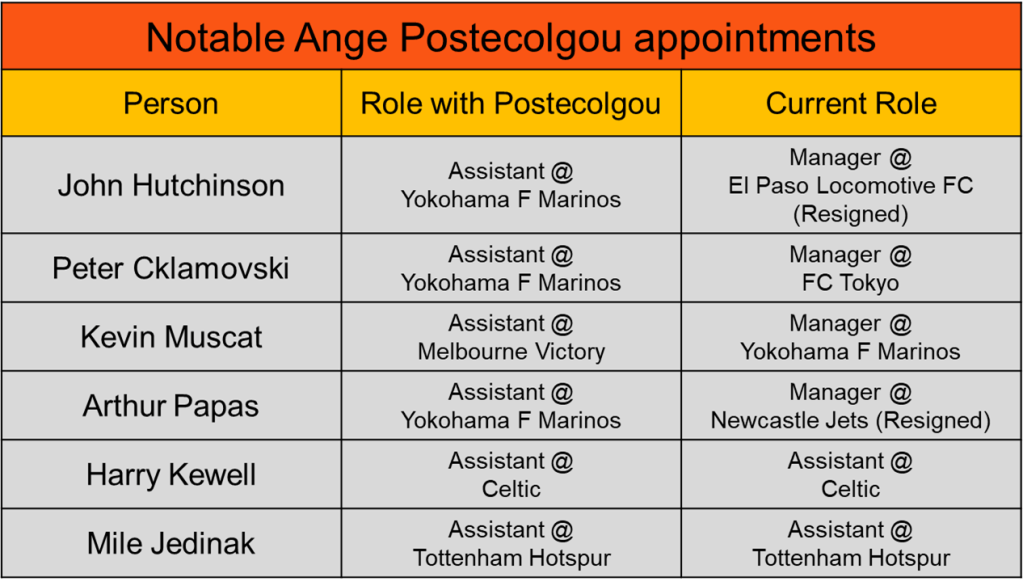
Encouragingly many of Postecoglou’s rough diamonds have gone on to shine in their new environments, and consequently, they are impacting the industry perceptions that Postecoglou faces pressure from. Postecoglou’s former assistant Peter Cklamovski was just announced as the manager of FC Tokyo, and Postecoglou’s former club Celtic are reportedly close to signing Australian prospect Marco Tilio. Postecoglou has always believed Australians can take on the world, and as his Aussie recruits succeed alongside him, the world is starting to believe that to.
Australian Trailblazers
Postecoglou may be the most high-profile trailblazer for Australian football, but he isn’t the only one. The Socceroos stunning World Cup performance increased Australian player profiles and contributed to high profile transfers, including Harry Souttar’s move to the Premier League. The City Football Group is another notable contributor, and has also been raising the profile of Australians for years. The group is responsible for giving Postecoglou his big break at Yokohama F Marinos, and more recently contributed to the European exports of Jordan Bos, Aiden O’Neil and Patrick Kisnorbo.
This belief in Australian talent is also becoming more evident in the A-League. Historically the league was a seen as a net importer of quality and between 2016 and 2021 the Johnny Warren Medal (for the A-League’s best player) was awarded to foreign players. Recently however an increased focus and belief in domestic talent has reversed this trend. The last two Johnny Warren medalists were Australian (Jake Brimmer and Craig Goodwin) and the league has begun to consistently export players.
This stream of Australian exports is quickly building its own momentum. Aussie enclaves are forming in overseas football circles (12 Australians are playing in the Scottish Premiership) which is improving the brand of Australian players in new regions, and results in further transfer interest. This is mostly clearly evidenced by leagues and clubs that return to the Australian markets, including Hearts (3 Australian players), Vikings (3 Australian players and St Pauli (2 Australian players). Australian players are finding more of their compatriots overseas which is helping their ability to carve out careers in foreign lands. Gone are the days when lone transfer hopes (such Daniel Azarni when he moved to Manchester City) are left to succeed or fail in remote isolation.

The changing status of Australian players and improved overseas networks are welcome changes for Australian football. These changes can be partly attributed to Australian clubs and people believing in each other to step into more challenging roles and given the chance to shine. Postecoglou’s mentality however, has not changed – he always believed. In 2014 Postecoglou’s Socceroos took on the World Cup with an aggressive game style, in 2015 he led Australia to winning the Asian Cup and since then he has been elevating people that he believed in, who mostly happen to be Australian. Jedinak is the latest in this line of appointees, but he won’t be the last. This will especially be the case if others in the Australian Football community can follow Postecoglou’s example.
There may always be a stigma to being an Australian rather than a European in the football world. There may always be road bumps and administrative hurdles from having AFC licensees rather than UEFA licenses. There will always be issues moving abroad and managing Australia’s relative remoteness. Ultimately though, Postecoglou shows us that it doesn’t matter if no one else believes in Australian Football, as long as Australian Football believes in itself.


 The Beautiful Game