
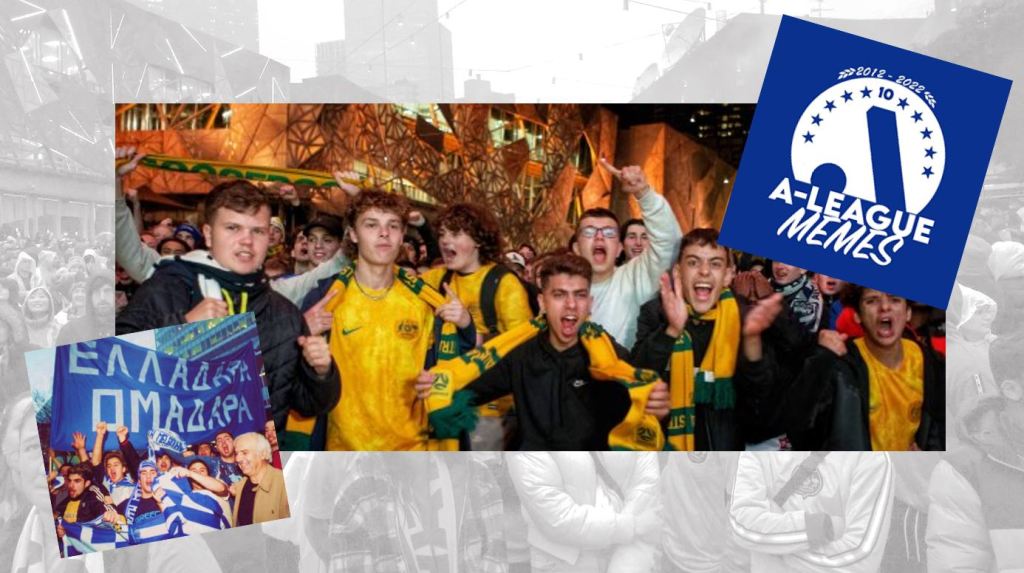
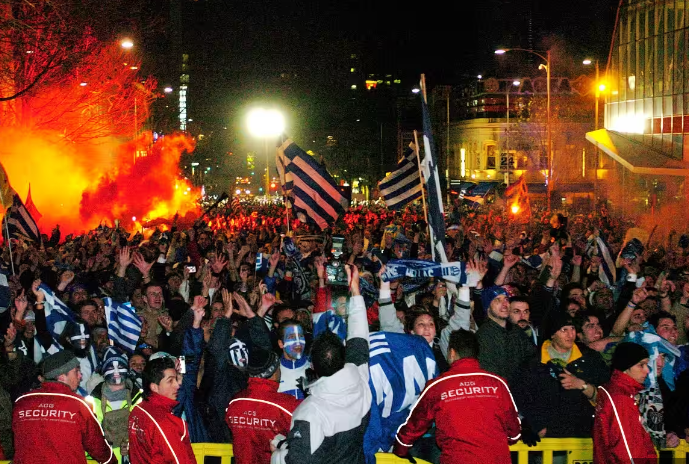
It happened in Melbourne during the early hours of the morning. While most people lay asleep and dreaming in the suburbs, the city was awake with an unfamiliar football passion. As a result of Greece’s unexpected progression in the 2004 Euro Cup Tournament, a massive demand from fans had forced the Government to hastily arrange Live Sites on Lonsdale Street for the Greeks and at Federation Square for the Portuguese to screen the final game. Over twenty thousand people gathered at these screenings, turning Melbourne’s streets into a sea of blue and white, rising and crashing with each wave of play from the match. When the final whistle blew and Greece miraculously claimed the title, the commitment of the masses was rewarded with a dizzying shared euphoria that disrupted the city’s nocturnal silence and carried on long into the morning. As professionals in suits trickled into their city, they were confounded by the remaining clusters of celebrating Greeks who remained on the streets, lighting flares and chanting. The city had woken up, but the football fans were still living a dream.
“[When] I arrived here and they told me this wasn’t a football country. Well, you could have fooled me.” said British presenter Kelly Somers as she concluded her coverage of the Women’s World Cup, such was the success of the tournament. It was a success most prominently evidenced by the hundreds of thousands of people who attended live sites to watch the games across the country. The images of shared euphoria, flares and limbs from Federation Square in particular featured prominently in the press, and went viral online. One can be forgiven for believing this is a deeply entrenched cultural tradition, however the Federation Square phenomenon is a new one to mainstream Australia that was only made possible by a critical mass of organic demand that has been able to overcome significant cultural obstacles.
The Greek experience differs greatly from the Matildas one, and in many ways helped pave the way for current Live Site success. For one, the technology to arrange temporary public screenings was far less developed and seldom used in Australia. The Greek screening also marked a significant departure from how Melbournians had been trained to use public space. Federation Square had only been opened two years prior to the Euro Cup and was one of only two public squares in Melbourne. The city had been deliberately designed without public squares specifically to diminish the ability of the public to congregate in colonial times, back when the British colonisers feared the threat of democratic revolts. Although the technology was always bound to become feasible, and Melbourne was always able to host large congregations, the 2004 Euro Cup Screening proved up the Live Site business case for future councils and organisers to consider.
Soon after Greece’s Euro 2004 triumph, Australia’s football community would come to enjoy a similar moment. In 2005 the Socceroos would qualify for their first World Cup in 32 years, with a penalty shootout victory against Uruguay. The match was watched by the largest SBS television audience ever and saw thousands of football fans sharing the moment together at Federation Square. The Federation Square moment was undoubtedly only made possible by SBS’s unique characteristics. SBS was a resident at Federation Square that could choose what was screened, it was a multicultural broadcaster which would have noted the Greek screening in 2004, and it was an important football stakeholder incentivised to create a special moment for the game. Unlike the Greek screening, the images of the Socceroo’s Federation Square celebration broke through to mainstream Australia, and captured the imagination of Australia’s entire football community. As a direct result of that screening football fans in Melbourne still share a fleeting thought before any major game – Is it being shown at Fed Square?

Shared memories like the 2005 World Cup Qualification have been vitally important to the football community. Live Site opportunities often require tight turnarounds and can be expensive to set up, meaning lobbying for Live Sites is difficult. Shared memories from previous experiences empower the community to pursue lobbying efforts. Of particular note were the successful illegal screenings of the 2021 Euro Cup in Melbourne, arranged by members of the Italian Community. The eventual victory by Italy saw thousands party on Lygon Street on a weekday morning. The event elicited memories of the 2004 Greek campaign, as professionals once again soaked in an unexpected atmosphere on their way to work. Images of the Lygon Street celebrations went viral nationally, and reminded the Australian Football community of the power of Live Sites ahead of the 2022 World Cup Tournament. However as the tournament drew nearer fans were shocked to learn there would be no major public screenings of the Socceroos’ matches. However, an unlikely hero emerged, in the form of the A-League Memes twitter page. The meme page successfully coordinated a last minute campaign for the fans, and resulted in Federation Square screening of the Socceroos’ World Cup games.
Coupled with the successful progression of the Socceroos at the tournament, fanatic scenes at Federation Square inspired other councils to arrange live sites around the country, and the numbers at these screenings grew with each match. Federation Square hosted a few hundred fans for the Socceroos match against France. Federation Square then hosted a few thousand fans for the Socceroos match against Tunisia. The final game of the campaign against Argentina saw Federation Square filled to capacity and the government was forced to open AAMI Park to accommodate the large crowds, at 5am on a weekend. The Live Sites arranged for the 2022 World Cup captured the imagination of the nation and images from Federation Square went viral. None of this would not have happened without the last minute push from the football community, driven by memories of the past Live Sites.

Even following successful Live Site events the Football Community faces opposition from some willfully ignorant voices in the media. Following the Federation Square Live Site for the Socceroos vs France match, the Media chose not to report on the celebrations of the majority, but rather, elected to focus on minor acts of disorder. These reports were seen by the football community as attacks on the game from media outlets that were protecting their competing sporting interests, as has long been the perception in Australia. Football Live Sites elicit a powerful emotional response from fans, and have an astounding ability to increase engagement with Football, so naturally, opposing sports and media outlets would be incentivised to downplay the safety and atmosphere of Football Live Sites. Media sensationalism creates controversy which impacts the prospect of future Live Sites. The media hysteria can tempt organising councils to avoid future controversy by not setting up Live Sites at all.
Despite some media narratives though, the 2022 World Cup Live Sites were ultimately a resounding success, which contributed to the arrangements for the Women’s World Cup. Every major city in the county arranged Live Sites ahead of the tournament, although these differed from previous arrangements. These were not independently arranged screenings, but rather they were ‘Official FIFA Live Sites’ which were set up to broadcast the entire tournament rather than single games. This meant that organisers were better prepared and even plan overflow options including those at AAMI Park and Rod Laver Arena. Live Sites for the Women’s World Cup have featured food, merchandise, safety barriers and trained marshals. This recent experience will no doubt inform organisers on how to arrange, and commercialise, future live sites.
Live Site attendees have also been impacted by these recent Live Sites. The convenient and committed screening schedule has also allowed fans to better prepare for attendance, with many bringing food and blankets to screenings. Ultimately though the best aspects of the Live Site cannot be prepared or commercialized. The outstanding success of Matildas is what ultimately allows Live Site experiences to make a lasting impact on fans, and following their remarkable tournament performance, it can be expected that many thousands of committed and new fans will walk away with unforgettable shared memories.

First time attendees can be forgiven for seeing the well-attended, commercialised Live Sites of the Women’s World Cup and take the experience for granted, however the success of these recent Live Sites has been built on decades of organic football culture in spite of many barriers. Live Sites have been championed by communities that have been somewhat marginalised by mainstream Australia, namely migrant groups and the soccer community. Their passion empowered them to express themselves and to share their most important moments with the public. The public in turn, has elected to join them in large numbers, share experiences and create memories. Live Sites are a great example of how diverse communities can contribute value for everyone, however they also remain an example of why continued lobbying is important.
Unfortunately just one day after the Matilda’s exit from the Women’s World Cup, news outlets chose to highlight incidents of disorder at the Live Sites, leaving many in the mainstream with an image of controversy rather than one of celebration. The media controversy has resulted in both the Premier and the Mayor of Melbourne coming out with statements, indicating that future Live Site events may be called off and astonishingly that the Matildas final World Cup game will not be screened at Federation Square.
The Matildas have just written arguably, the greatest story in Australian sport, and Live Sites played a huge part in amplifying that joy and bringing the country together. However, despite overwhelming success it appears football communities will again have to unite in order to ensure this great cultural practice continues.


 The Beautiful Game