
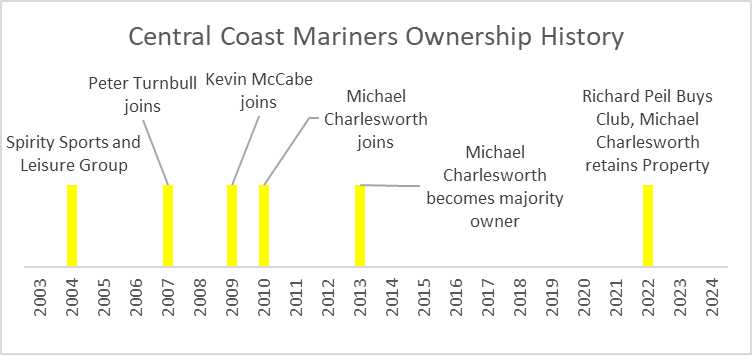
In 2004 Central Coast were set up to fill the regional spot in the A-League. Owners included the Spirit Sports and Leisure Group, Alex Tobin, former Socceroo, Ian Kiernan, of Clean Up Australia.
In 2007 Peter Turnbull, property developer, bought into the Central Coast Mariners to become majority shareholder and chairman.
In 2009 Kevin McCabe, property investor and owner of Sheffield United, invested $1 million in the Central Coast Mariners though Scarborough Group International Ltd. and subsequently the The Mariners FC Unit Trust. He soon after joined the board.
In 2010 the Global Financial Crisis had impacted Turnbull’s property interests as well as his ability to fund the club, allowing Michael Charlesworth to invest into the club and join as co-director.
In 2013 Michael Charlesworth, British telco businessman, gained majority control (64%) of the club after acquiring the ownership stakes of Peter Turnbull and Lyall Gorman.
By 2017 Michael Charlesworth held 73% of the club and was seeking to convert a debt owed by the club to his company into full ownership. This intention was not entirely successful.
By 2018 Michael Charlesworth held 82% of the club while a group of 11 smaller shareholders held 18%.
In 2020 the club was put up sale by Michael Charlesworth. The media reported that the club could also face relocation. Reported bids from Abdul Helou, technology businessman, and Manchester United, did not come to fruition. It was reported that bids of $4 million would be considered for the licence but club management suggested the actual figure would have to be higher.
In 2022 Richard Peil, Canberra based fitness businessman, took majority ownership of the club with Michael Charlesworth retaining a minority ownership of the club. Michael Charlesworth also retained full ownership of the Mariners Centre of Excellence in Tuggerah.
Insights
Central Coast has benefited from being the sole national representative of the area. It has high community engagement and has also been able to benefit as the sole tenant of an appropriate stadium. However the small size of the market has resulted in some challenges. The initial set up leveraged multiple owners and some legacy from the Norther Spirit Football club, not just in location and the name of the ownership vehicle but in personnel including Ian Ferguson a former Rangers player. Rangers of course were former owners of the Norther Spirit. The club however has never been able to secure financially strong ownership to provide it with an impressive cash flow, the most investable component of the team was in fact developed a few years after formation.
In 2010 the club’s owners (Peter Turnbull, Lyall Gorman and Mike Charlesworth) bought a parcel of land at Tuggerah on the Central Coast from a local RSL club for $7.5m with $4.5m paid upfront. The initial intention was for the land to host a club training base and for the land surrounding the base to be developed. The Centre of Excellence has since seen the establishment of social and commercial property, and government support in the form of a $10 million Government grant and Council planning approval which supported the football club. Interestingly the latest ownership exchange of the club did not include ownership of the land, which has rather been retained by Michael Charlesworth.
During his tenor as majority owner Charlesworth developed the Centre of Excellence property while sparingly investing in the club which saw poor on-field performance and was threatened with licence removal. Charlesworth also experimented with club relocation which included hosting matches in Canberra and North Sydney. In 2017 under Charlesworth, the Mariners bid for management rights of the Gosford Stadium. Their bid included a hotel and stadium redevelopment. They were ultimately unsuccessful in their bid when Central Coast Council awarded the rights to VenuesLive.
The Centre of Excellence and Stadium Plays suggest that Charelsworth has used the club as a ‘property play’. The eventual on sale of the club operations Richard Peil however do not include the property, and are more reflective of a ‘pure football play’, something that has been somewhat reflected in the club’s recent results.
Limitations and considerations
Exact ownership holdings are not clear, especially in times of multiple owners. The identities of the multiple minority owners are also unclear. It is possible the ownership research presented is incomplete. The nationalities of public owners does not necessarily reflect the commercial ownership structure of the club.


 The Beautiful Game