
In 2008 Football Federation sought to expand the A-League. In the years following it would add North Queensland Fury and Gold Coast United to the competition. A latter round of expansion would result in the acceptance, and eventual demise of the West Sydney Rovers bid, but also a hotly contested expansion bid for a second A-League team to be based in Melbourne.
The FFA received three bids from Melbourne:
- The Colin De Lutis bid. At one point believed to contested under the name ‘Melbourne City FC’.
- Southern Cross FC. A bid backed by South Melbourne President Jim Marinos with the club to be based at Casey Fields.
- The Peter Sidwell bid. A well known racing identity also seeking to base a club in the city’s outer south-east .
In 2008 the FFA ultimately selected with the Peter Sidwell bid, supported by partners operty developer David Kobritz, furniture supplier Michael Catalano, former Victorian soccer executive Manny Galanos, lighting distributor Joe Mirabella and entertainment promoter Patrick Prendergast. The consortiums intention at the time was to base the team in the South Eastern suburbs and play matches in the city.
In 2010 Melbourne Heart entered the A-League competition, this coincided with the 5 year exclusive market agreement held by Melbourne Victory.
The club would struggle financially in its early years and in 2013 South Melbourne bid for its licence, although this bid was knocked back.
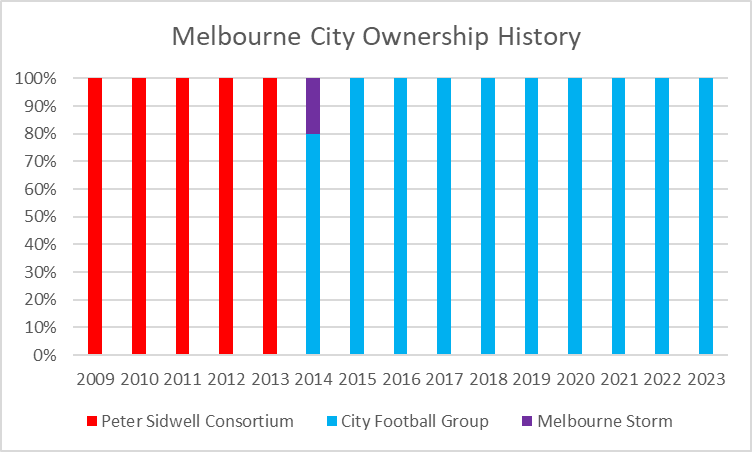
In 2014 they were acquired by City Football Group (80%) in partnership with the owners of Melbourne Storm (20%) Holding M.S. Australia Pty Ltd. In 2014 they were rebranded as Melbourne City.
In 2015 City Football Group bought out Holding M.S. Australia Pty Ltd and became full owners of Melbourne City.
Insights
City Football Group
The City Football Group is widely discussed for its growing influence in Football. Over time its interests have grown as it has acquired shares of football clubs around the world, the most notable of which are Manchester City, New York City, Melbourne City and Girona. This football group model is increasingly being replicated by others around the world. Initially the group was more disciplined about acquiring controlling ownership and rebranding clubs in line with Manchester City, over time however this approach has been relaxed. The Group has delivered massive resources to Melbourne City, as well as a massive network which has resulted in higher quality football personnel into the club, and greater opportunities for people to move away from the club. Beneficiaries of the network include Aaron Mooy and Daniel Arzani who were transferred out from Melbourne City to Manchester City.
In 2008 the Abu Dhabi United Group took over Manchester City. The group is owned by Mansour bin Zayed Al Nahyan of the UAE.
In 2013 the City Football Group was founded to be the umbrella organisation of the Abu Dhabi United Group’s football operations.
In 2015 CMC Holdings bought into City Football Group
In 2019 Silver Lake invested in City Football Group (10%) from UAE
In 2022 Silver lake increased their stake (20%) in city football group from China
Training Base
In 2010 they announced a training facility at La Trobe
In 2015 City Football Group upgraded the Melbourne City facilities
In 2020 Melbourne City moved training base to Casey. This followed the failed Team 11 A-League bid to be based in the South East
The exited base was replaced with the Home of the Matildas but on a different part of the uni
Other Insights
Melbourne Heart represented the first time a city has two A-League clubs. At the time of expansion the FFA was beginning to put together a bid to host the world cup, which was also part of the justification of the North Queensland and Gold Coast teams. Melbourne Heart not only seemed like an opportunity to build off Melbourne Victory’s massive success at the time, but also contributed to the economic case of Melbourne’s first modern rectangular stadium. As far back as 2007 a second Melbourne club has been mentioned as a partner tenant of such a stadium.
Melbourne Heart however struggled financially early on, and it appears the grand ambitions of the original bidding group had not materialised as planned. The acquisition by City Football Group was a much needed lifeline for the club that lived in the shadow of Melbourne Victory. Victory’s shadow was not the only identity crisis the club had faced. The rejection of the original Southern Cross bid by the FFA and the subsequent rejection of South Melbourne’s bid to buy Heart can be seen by some to show Melbourne Heart also lived in the shadow of ‘old soccer’. It’s early marketing advances for the ‘purists’ of the game thus failed to connect with old soccer fans of the NSL and the new football fans who had experienced Melbourne Victory.
Melbourne City has stabilised now, with a training base in the South East, a name and colours aligned with Manchester City, years of onfield success, a financial basis to focus on football and even the presence of Western United which have helped put Melbourne City’s crowds in a more appropriate perspective. Funnily enough if original bid components played out as planned, Melbourne Heart would have entered the competition as Melbourne City and based in Casey from day 1.
Limitations and considerations
Information has been accumulated based on publicly available reports and may not be entirely correct.


 The Beautiful Game