

Recent comments from the APL have struck a nerve. Neither Canberra nor Newcastle are assured of a place in next years’ competition and fans are worried about what this means for their clubs and the League as a whole. Unfortunately this exact scenario has happened before. As Canberra may be, Sydney Rovers were denied a place in the competition after being tentatively awarded an expansion place. As Newcastle, North Queensland Fury were removed from the competition after failing to find a new owner.
A-League fans have been burnt out by years of uncertainty surrounding the competition. Clubs have come and gone over the years, and relentless negative headlines have fatigued fans with worry about whether their clubs will survive, and even at times whether the league itself will survive. Is this sentiment reflective of the reality though? We took a look at the history of A-League ownership to find out.
Read about your club’s ownership history in our special analytical series

A-League Ownership is more volatile due to Ownership Structures
In short, the A-League does in fact have more volatility in its ownership than the NRL and AFL. Data shows that significant ownership changes have happened in the A-League every single year. One reason for this is the differences in ownership structures
NRL and AFL clubs primarily operate with membership based ownership structures. Membership ownership structures provide resilience against ownership changes because a consensus is needed amongst a broad group to approve the sale of a club or its winding down. Private ownership structures however, particularly those comprised of single owners, don’t require a consensus and are more at the whims of specific owner decisions.
Because A-League clubs primarily operate with private ownership structures this means more decision making power is concentrated to the private owners. This means when someone wants to buy a club (i.e. Traktovenko increased his stake in Sydney FC) they often only need to convince a single person. On the flip side, if someone wants to sell a club (i.e. Charlesworth selling Central Coast) they can do so when and as they please.
Read about your club’s ownership history in our special analytical series
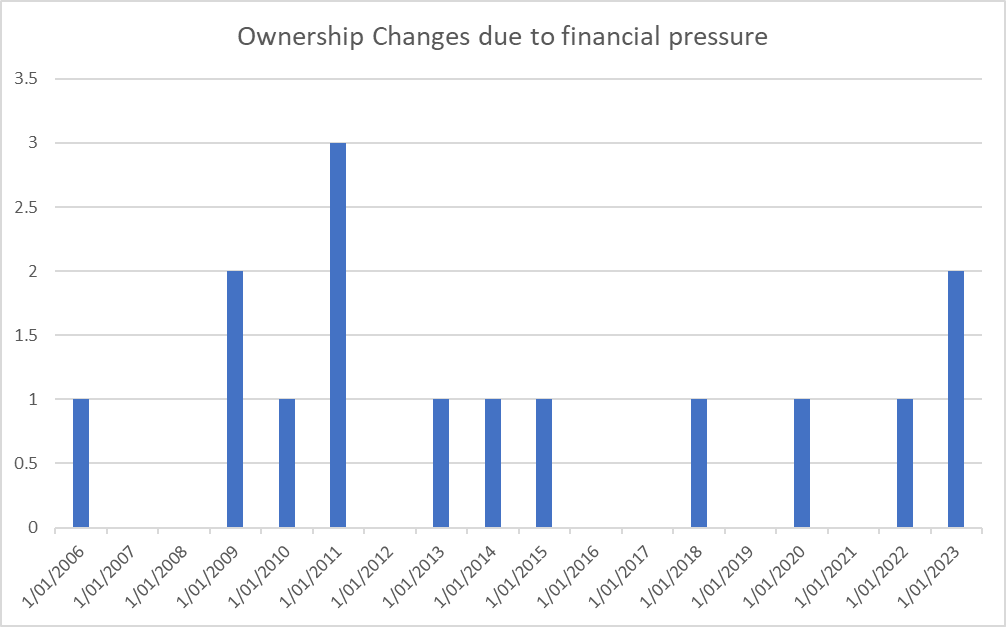
A-League ownership involves more financial pressure
As well as ownership structures being different, differences in the demands of owners have played a role in ownership volatility, including different financial demands. AFL and NRL clubs operate more sustainable business models that generate financial profits. This means their owners (their members) don’t need to provide any additional funding beyond their membership fees, and don’t suffer additional pressures to change the status quo.
A-League clubs on other hand often operate at a financial loss. This means that A-League owners need to constantly find external sources of funding to invest in their clubs in order for them to continue their operations each year. Ownership changes due to financial pressure have occurred regularly frequently in the A-League and include cases where the past owners of Adelaide United (Bianco), Brisbane Roar (Lions FC), Newcastle Jets (Tinkler) and Perth Glory (Sage) walked away from clubs entirely and handed back their licences.
Read about your club’s ownership history in our special analytical series

A-League administrative resources are more limited
One important consideration when assessing the financial profitability of AFL and NRL clubs though, is the contribution each of the Leagues makes to its clubs. Significant broadcast deals allows for the AFL and NRL to contribute significant funds to clubs, at times up to 50% of their revenue. This significantly supports the status quo and help aliviate pressure on the existing ownership models, meaning no change is necessary.
The A-League does not have this same luxury. The contribution to clubs (reported to be around $2m) is not large enough to ensure financial sustainability, which makes clubs less resilient financially and puts pressure of owners. A-League administrators have instead left their major resource allocations to be more reactive in crisis times.
This occurs when the League administrators take temporary ownership of a club while they search for a permanent owner. In these cases, clubs have been funded by administrators’ other income sources (i.e. FFA’s grassroots registration fees or the APL’s private equity). However the League administration has a clear bias. Big city clubs have been owned by League administrators for multiple years (Perth, Adelaide), big city clubs have even been founded by administrators (Victory, Wanderers), but regional clubs have been left to disband (North Queensland, Gold Coast). The bottom line is League administrators will step if they feel it is necessary, but don’t have the resources to eliminate ownership volatility.
Read about your club’s ownership history in our special analytical series
A noteworthy perception bias
An important note on A-League ownership volatility is fan perceptions, and how it has been influenced by the AFL and NRL. The past twenty years have been extremely stable for these leagues, however both struggled with significant upheaval as they nationalised from state competition. The AFL faced insolvency in the 1980s and the NRL was birthed from the painful super league wars. Other league have a history which is arguable even more volatile the than the A-League, including the Super Rugby and NBL.
Overseas where football also operates with significant private ownership, it is not unusual for clubs to go insolvent and restart as a phoenix club – funnily enough similar to how Gold Coast United have found themselves today. These overseas football leagues though have a resilient league structure which provides an aura of stability even when the clubs themselves are unstable.
Unfortunately the A-League suffers in that it uniquely combines an expensive product similar to the NRL, private ownership of overseas football, and a desire for league stability like the AFL that rejects promotion and relegation. It is an unusual mix that impacts ownership stability.
As a result the league administrators have created eras of uncertainty over their time. This included a demand led expansion which was enacted carelessly during a Global Financial Crisis, a prolonged interrogation of Wellington’s participation, a League administration change into the hands of Private Equity, and more recently supply led expansion driven in an attempt to generate league growth. In between has been a devastating COVID era!
How can the A-League improve ownership certainty
Considering the lessons from above, what can be done to improve A-League ownership uncertainty? Well, there are a few clear lessons, some of which are already being enacted by clubs.
- Sustainable Core Business Models:
A reduction in operating costs (stadiums, staff) and an increase in revenue (memberships, sponsors) should be the first action item in reducing negative ownership volatility. Club like Melbourne Victory enjoyed over 20 years of stability in large part due to their massive fan base and revenue. - Alternative Revenue Streams:
Just as NRL clubs enjoy revenue from Leagues Clubs A-League clubs need to invest in other revenue generating business units. Central Coast Mariners has been able to withstand significant financial pressure thanks to its former ownership of a property, the Mariners Centre of Excellence. - Diverse Ownership Groups:
Although clubs may not be able to change to membership models, as North Queensland Fury’s failed attempts shown, large and diverse ownership groups (including Adelaide’s current consortium), have proven less volatile than clubs owned by individuals (Clive Palmer, Nathan Tinkler, Terry Serepisos) which are more prone to economic risk.
Unfortunately our assessment is that the above items are not easily enacted. Ownership volatility has been a mainstay of the A-League since the very start, and as long as the competition stays as it is fans can expect this to continue for a long time to come.
The Data
| Year | Team | Category | Detail |
| 1996 | Perth Glory | Establishment | In 1996 Perth Glory entered the NSL. Nick Tana, Chicken Treat |
| 1999 | New Zealand Knights | Establishment | Entered NSL as Football Kings |
| 2000 | Newcastle Jets | Establishment | In 2000 local businessman, Con Constantine bought remnants of the Newcastle Breakers from David Hall. |
| 2003 | Adelaide United | Establishment | Enters NSL with financial backing of Gordon Pickard. |
| 2004 | Central Coast | Establishment | In 2004 Central Coast were set up to fill the regional spot in the A-League. Owners included the Spirit Sports and Leisure Group, Alex Tobin, former Socceroo, Ian Kiernan, of Clean Up Australia. |
| 2004 | Melbourne Victory | Establishment | In 2004 Melbourne Victory was announced as a foundation club. The Melbourne Victory bid was led by Geoff Lord of Belgravia Leisure. FFA came in as a minority shareholder after the bid fails to raise sufficient capital. FFA bought out the following season. |
| 2004 | New Zealand Knights | Major Ownership Change | Restructured as New Zealand Knights. Owned by consortium of local interests, primarily Anthony Lee (20%), Brian Katzen & Maurice Cox (60%) |
| 2004 | Sydney FC | Establishment | In 2004 Soccer NSW announced a bid for the A-League, but left the consortium after having issues with the Lowy led bid group |
| 2005 | Brisbane Roar | Establishment | In 2005 Queensland Lions Soccer Club bid accepted to join A-League. |
| 2006 | Adelaide United | Major Ownership Change | In 2006 Nick Bianco became sole owner of Adelaide United. |
| 2006 | New Zealand Knights | Demise | FFA revoked licence from the Knights |
| 2006 | Perth Glory | Major Ownership Change | In 2006 Football Federation Australia took control of Perth Glory after Nick Tana and the ownership group agreed to hand back the licence. |
| 2007 | Central Coast | Major Ownership Change | In 2007 Peter Turnbull, property developer, bought into the Central Coast Mariners to become majority shareholder and chairman. |
| 2007 | Perth Glory | Major Ownership Change | In 2007 a three man consortium took ownership of the club including Tony Sage |
| 2007 | Wellington | Establishment | In 2007 Terry Serepisos funded the licence for Wellington. They were given a three year licence. |
| 2008 | Melbourne City | Establishment | In 2008 the FFA ultimately select Peter Sidwell bid to enter A-League. |
| 2008 | North Queensland Fury | Establishment | Don Matherson bid granted access by FFA |
| 2008 | Perth Glory | Major Ownership Change | In 2008 Tony Sage became the sole owner of Perth Glory after buying out partner Brett McKeon and following the exit of John Spence. |
| 2009 | Adelaide United | Major Ownership Change | FFA takes ownership of the club after Nick Bianco handed back the club’s licence. |
| 2009 | Brisbane Roar | Major Ownership Change | By 2009 Queensland Roar was owned by a number of parties (mostly Coffee Club (30%) and Luxury Paints (15%). Lions had divested incrementally due to financial pressures. |
| 2009 | Gold Coast United | Establishment | Clive Palmer Consoritum granted entry to the League |
| 2010 | Adelaide United | Major Ownership Change | In 2010 a Local Consortium took ownership of the club from the FFA. |
| 2010 | Newcastle Jets | Major Ownership Change | In 2010 Constantine was stripped of his licence by Football Federation Australia (FFA) and it was reassigned to mining businessman, Nathan Tinkler. |
| 2011 | Brisbane Roar | Major Ownership Change | In 2011 the FFA took control of the club after the existing ownership group handed back their licence following financial losses. |
| 2011 | Brisbane Roar | Major Ownership Change | In 2011 the Bakrie Group, an Indonesian industrial conglomerate, purchased a 70% share in the Brisbane Roar, with the FFA retaining a 30% share. In 2012 the Bakrie Group acquired full ownership of the club. |
| 2011 | North Queensland Fury | Demise | FFA revokes licence of the club |
| 2011 | Wellington | Major Ownership Change | In 2011 Terry Serepisos encountered financial difficulties and was forced to relinquish ownership of the club. The club was taken over by a group of local businessmen, Rob Morrison and including Gareth Morgan, Lloyd Morrison and John Morrison. |
| 2012 | Gold Coast United | Demise | Gold Coast United stirpped of licence |
| 2012 | North Queensland Fury | Re-establishment | Community Club re-established in NPL |
| 2012 | Sydney FC | Major Ownership Change | In 2012 Traktovenko became the club’s majority owner. |
| 2012 | Wanderers | Establishment | In 2012 the FFA decided to launch a club itself after finding no appropriate financial backer. After securing an investment from the Federal Government the FFA moved ahead to establish a club in Sydney’s West. |
| 2013 | Central Coast | Major Ownership Change | In 2013 Michael Charlesworth, British telco businessman, gained majority control (64%) of the club. |
| 2014 | Melbourne City | Major Ownership Change | In 2014 Melbourne Heart is acquired by City Football Group (80%) in partnership with the owners of Melbourne Storm (20%) and rebranded as Melbourne City. |
| 2014 | Melbourne Victory | Major Ownership Change | In 2014 minority holders Robert Belteky and Harry Stamoulis decided to divest themselves and offered up their collective 35% stake in the club. |
| 2014 | Wanderers | Major Ownership Change | In 2014 the FFA sold the club to a consortium of Paul Lederer, Jefferson Cheng, Glenn Duncan and David Slade were part of the consortium of owners |
| 2015 | Melbourne City | Major Ownership Change | In 2015 City Football Group bought out Holding M.S. Australia Pty Ltd and became full owners of Melbourne City. |
| 2015 | Newcastle Jets | Major Ownership Change | In 2015 Tinkler’s licence was terminated by the FFA after he placed the club in voluntary administration. Tinkler was declared bankrupt in 2016. |
| 2016 | Melbourne Victory | Major Ownership Change | As at 2016 Anthony Di Pietro and Mario Biasin remained majority owners. |
| 2016 | Newcastle Jets | Major Ownership Change | In 2016 the FFA announced the sale of the club to the Ledman Group, a Chinese based LED signage manufacturer. |
| 2017 | Gold Coast United | Re-establishment | Gold Coast United Revived as a Community Club |
| 2018 | Adelaide United | Major Ownership Change | In 2018 a Foreign Consortium took ownership of the club. |
| 2018 | Macarthur | Establishment | South West Sydney FC bid (Gino Marra and Sam Krslovic) merges with United for Macarthur bid (Campbelltown City Council and Lang Walker). |
| 2018 | North Queensland Fury | Community Club Demise | Club disbanded |
| 2018 | Western | Establishment | In 2018 the Western Melbourne Group bid for a spot in the A-League. The project was conceived by Steve Horvat who brought together key stakeholders including Football Agent Lou Sticca, KPMG Partner Maurice Bisetto, Local Council The City of Wyndhum to form the foundation of the bid. Birmingham Sports Holdings reported as initial funders but pulled out |
| 2019 | Sydney FC | Major Ownership Change | In 2019 Traktovenko again increased his stake in the club via Strada Investments after purchasing the 10% interest held by the Lowy Family Group. |
| 2020 | Macarthur | Major Ownership Change | In 2020 Lang Walker (Property Developer) sold his 50% share in Macarthur to Roy Mammone (Sydney Trucks and Machinery), Michael Gerace (Property Developer). |
| 2020 | Newcastle Jets | Major Ownership Change | In 2020 the FFA terminated Ledman’s licence. The club was taken under the control of a group of other A-League clubs, Sydney FC, Western United, and Western Sydney Wanderers. |
| 2021 | Melbourne Victory | Major Ownership Change | In 2021 Richard Wilson had a falling out with the majority owners and exited the club by selling his shared to fans. |
| 2022 | Central Coast | Major Ownership Change | In 2022 Richard Peil, Canberra based fitness businessman, took majority ownership of the club with Michael Charlesworth retaining a minority ownership of the club. Michael Charlesworth also retained full ownership of the Mariners Centre of Excellence in Tuggerah. |
| 2022 | Melbourne Victory | Major Ownership Change | In 2022 Melbourne Victory sold a minority stake to 777 Partners. This marked the first foreign ownership of the club. 777 Partners also supported the club though sponsorship of an associated company Bonza airlines. |
| 2022 | Sydney FC | Major Ownership Change | In 2022 Russian it was made apparent that David Traktovenko had transferred ownership of the club to his daughter Alina Traktovenko and son-in-law Scott Barlow. 2% of the club however remained in the hands of the Crismale family and two other Australian shareholders. |
| 2023 | Perth Glory | Major Ownership Change | In 2023 Tony Sage relinquished his ownership of Perth Glory and the Australian Premier Leagues took control. |
| 2023 | Western | Major Ownership Change | In 2023 the AFR reported that Jaszac alone were the primary leads in the Western Melbourne Group. It is understood that the Western Melbourne Group also comprises a number for smaller investors. |
| 2024 | Perth Glory | Major Ownership Change | In 2024 the Pelligra group successfully acquired the club from the APL. |


 The Beautiful Game